.png)

Share this post
AI tax software for document processing: a buyer's guide
The binder is the product
Strip away the dashboards and every tax engagement starts the same way: a pile of documents. W-2s, 1099s, K-1s, brokerage statements, prior-year returns, and whatever the client photographed on their kitchen table. Firms searching for AI tax software for document processing are trying to solve that pile, because everything downstream, prep, review, planning, runs on what gets read out of it.
The market answers with two very different technologies wearing the same label. Knowing which one you are evaluating saves a wasted pilot.
OCR scans. Document AI reads.
Scan-and-populate tools have existed for twenty years. They match a document against a known template, lift the numbers from fixed positions, and push them into fields. On a clean, standard W-2 they work. The moment the document deviates, a new brokerage statement layout, a K-1 footnote, a corrected 1099 stapled behind the original, template matching degrades and someone re-keys after all.
Document AI reads the way a preparer reads. It understands that this page is a consolidated 1099, that these three sections are interest, dividends, and proceeds, that the footnote on page 14 modifies the number on page 3. Filed's document processing is built this way, which is why the messy majority of a real binder, not just the specimen forms, comes through structured.
What to expect from real document processing
Four capabilities separate serious products from demos.
Coverage of the hard documents. Anything can read a W-2. The test is a consolidated brokerage statement with wash sales, a multi-state K-1 with footnotes, and a scanned-at-an-angle mortgage statement. Ask to watch those.
Citations on every value. Each extracted number should link back to the exact page and line it came from, so verification is a click instead of a hunt. Without citations, extraction just relocates the checking work. This is the standard Filed holds itself to on every output.
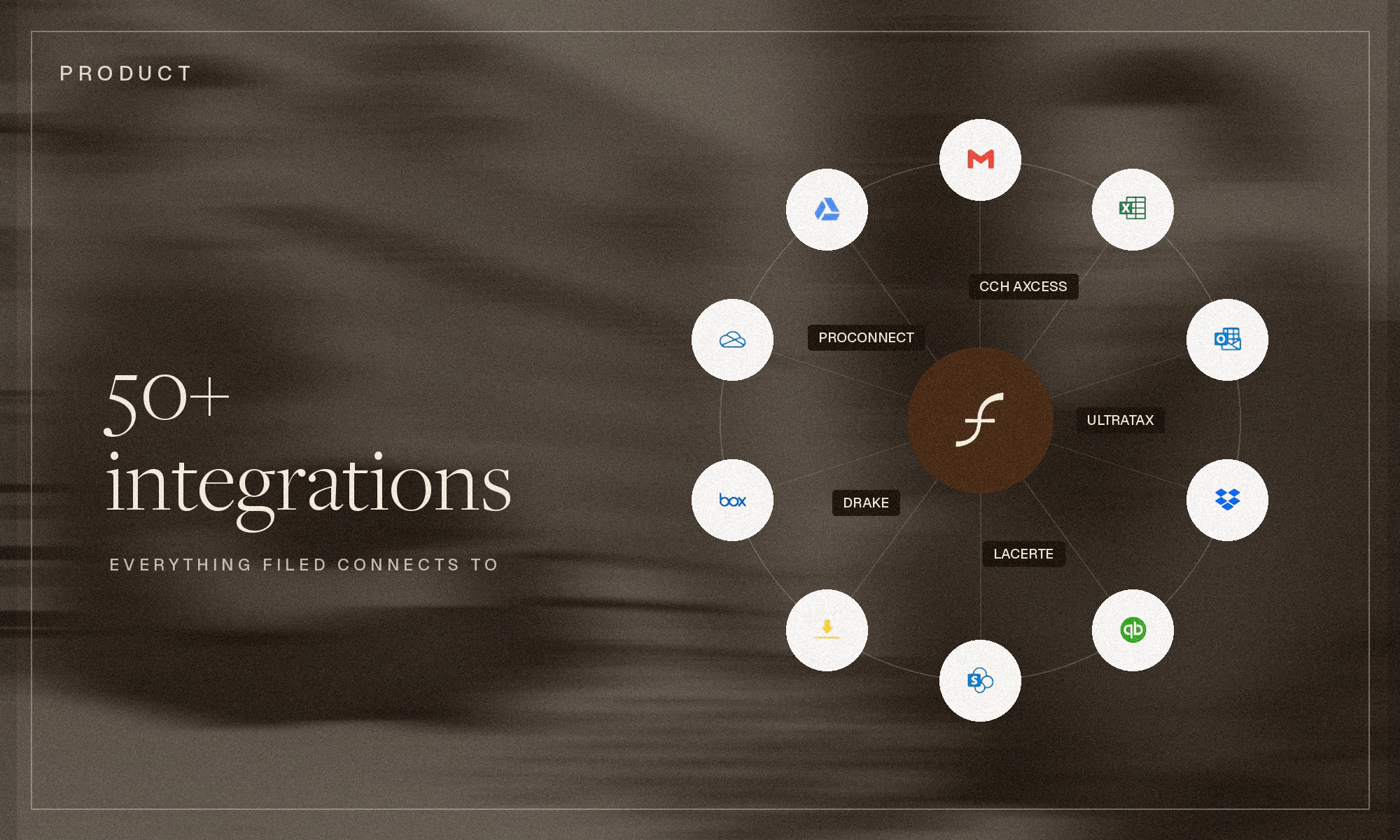
Output that lands somewhere useful. Extraction that ends in a CSV is half a product. Filed enters the data directly into Drake, ProConnect, UltraTax, and CCH Axcess, and builds the organized binder and lead sheets alongside, so processed documents become a populated return, not an export.
Awareness of what is missing. Reading what arrived is table stakes; noticing that the second K-1 never arrived is where document intelligence starts paying for itself. Processing should reconcile against the prior year and flag the gaps.
The security questions, settled early
Tax documents are about the most sensitive files a firm holds, and document processing means handing them to a vendor. Settle this before any pilot: SOC 2 Type II certification, U.S. data processing and storage, encryption in transit and at rest, and IRS 7216-compliant handling. Then ask the question vendors answer vaguely: does client data train shared models? At Filed the answer is no, and it is in writing.
One more that gets missed: retention. Ask what happens to processed documents when an engagement ends, and who inside the vendor can see them meanwhile. A clean answer takes one sentence. A messy answer takes a paragraph and should end the conversation.
How to run a two-week pilot
- Pull ten real binders from last season. Include your worst: the shoebox client, the multi-state K-1, the 300-page consolidated statement.
- Process them and time the full loop. Upload to populated return, including the fixing of anything read wrong. Vendor accuracy claims measure the happy path; your pilot measures the whole path.
- Verify against the citations. Have a reviewer spot-check twenty values per return. The point is not catching errors, it is testing how fast checking goes when every number links to its source.
- Count the escapes. Anything the system misread confidently, without flagging, is the number that matters. Uncertain-and-flagged is fine; wrong-and-confident is the risk.
Frequently asked questions
What document types can AI process today?
The standard set is broad: W-2s, all common 1099 variants, K-1s including footnotes, brokerage statements, mortgage and property tax statements, and prior-year returns. Handwriting and poor scans are read with flagging for review rather than silent guessing.
Is this only useful for 1040 work?
No. Filed processes documents across 1040, 1065, 1120, 1120-S, 1041, and 990 engagements, and entity binders are usually where the document load is heaviest.
What accuracy should we expect?
Ask vendors for their numbers on your documents, not their benchmarks. The honest framing: extraction is strong enough to be the default, and the citation trail exists so your team verifies quickly instead of trusting blindly.
Where to start
Run the two-week pilot above on your own binders and let the timing data decide. Filed will process them inside your tax software, with a 60-day money-back guarantee. Related reading: can AI automate partnership tax returns?
Subscribe to our newsletter
Explore our latest insights
Discover valuable articles to enhance your knowledge.