
Share this post
AI tax software: what actually works for accounting firms in 2027
Most AI tax software still does not work. Jason Staats, a former firm owner whose recommendations come from a community of over 1,000 accounting firms, estimates that upwards of three quarters of tax workflow tools are "a very exciting landing page" that "in practice doesn't actually work." The tools earning their keep are narrow: intake automation, delivery automation, and import with source-document tie-back. The only reliable way to evaluate any of them is evidence from firms already using them in production.
That is the short version. The longer version matters if you are budgeting for the 2027 season, because the gap between what AI tax vendors claim and what their products do has never been wider.
Why do most AI tax tools disappoint?
Because the marketing shipped before the product did. Venture capital sees tax automation as a huge market, so a record number of companies are pitching AI as, in Staats' words, "this miracle solution for tax preparers to just save untold hours." His assessment of most of them: "They raised money, they made a landing page, but none of my friends use it."
The cost of this is not just wasted software spend. Staats notes that many tax professionals "are getting a really negative perception of AI because so many of these tools are overselling their capabilities." A firm that buys an overpromising tool in November and watches it fail in February does not just churn. It writes off the whole category for a few years, including the parts that work.
The parts that work are worth separating out, which is what the rest of this article does.
How should a firm evaluate AI tax software?
Ask firms that already use it, and discount everything else. Staats puts it bluntly: "Friends don't let friends use software that nobody else likes." And on vendor sales channels: "In what world do we trust an incentivized salesperson to give you independent information?"
In practice that means a short checklist:
- Reference firms running it in production, ideally through at least one full filing season plus extensions.
- Narrow scope done well. A tool should name what it does not do. Staats: "I appreciate a tool having boundaries to say we do this really, really well."
- Works with the tax software you already run. Changing tax software mid-journey is where efficiency goes to die. Staats again: "If you want to save your tax team time, you will not do it by changing tax software, you will do it by upgrading your tax workflow software."
- Verifiable output. If the tool imports a number or flags an error, you should be able to trace it back to the source document without hunting.
- A pricing model you can predict at your return volume.
Beware the opposite pattern, the tool that claims to cover the whole workflow. "A tool that goes from step one to step 10 and does a half-baked version of every single step, that is actually a nightmare to live with."
Which AI tax tools are actually working in 2027?
A small list, and it is practitioner-sourced rather than ours. In his 2027 annual tax software review, Staats keeps "a really small shortlist of the tools that I consistently see firms having success with." Excerpting the leaders from his rankings, with his one-line reads:
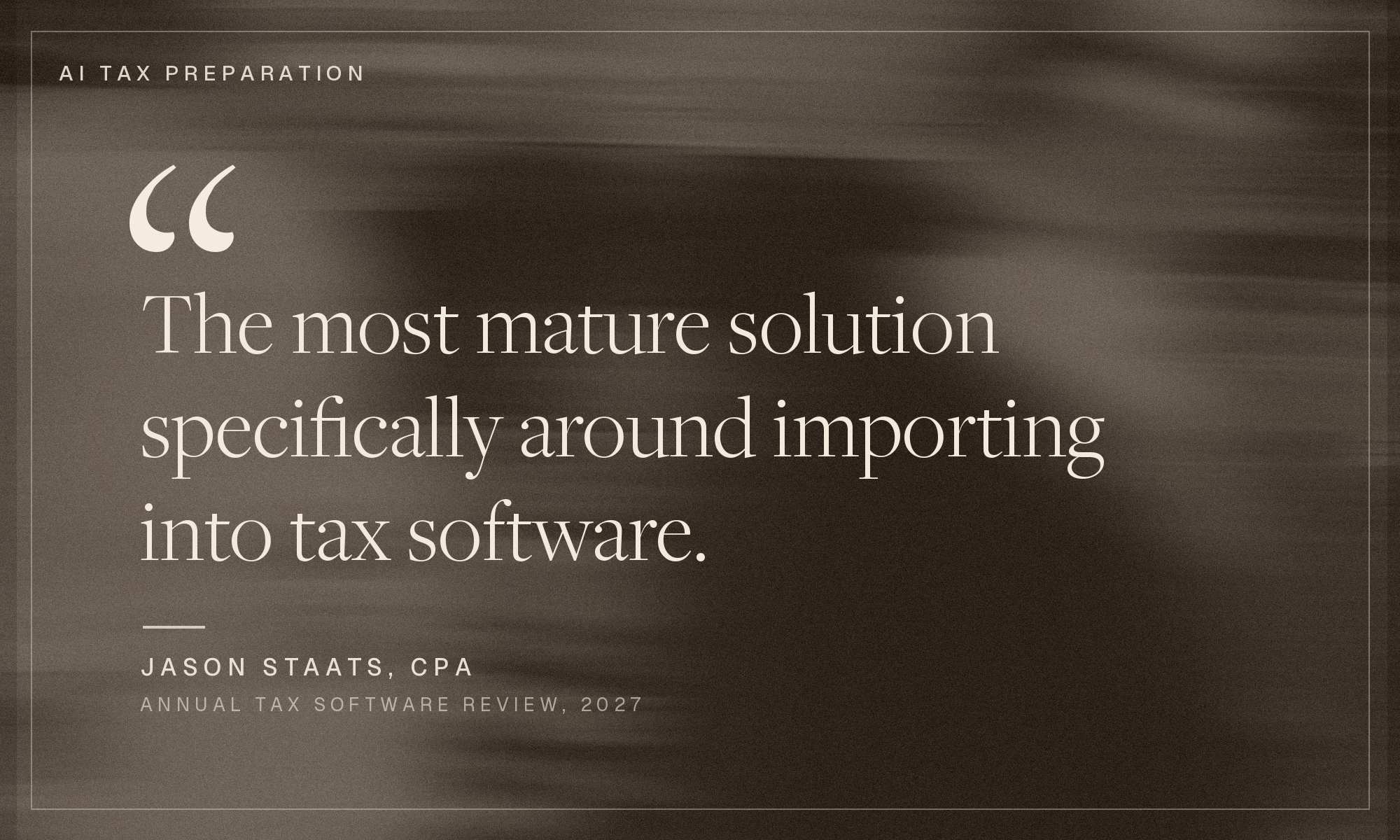
- Filed, for import and review: "the most mature solution specifically around importing into tax software," where you can "in a really nice visual way see how all the numbers that got imported tie back to your documentation."
- Soraban, for intake: strong document collection and follow-up automation, with delivery features emerging.
- StanfordTax, for document requests: excels at request generation and unified collection.
- TallyFor, for entity workflows: evolved from a trial balance tool into a leading business tax prep workflow.
- Truss, for intake and delivery: a common landing spot for firms leaving SafeSend.
That is an excerpt, not the full picture. His complete rankings, including the tools he rates as contenders, watchlist entries, and ones to avoid, are in the full video and his app recommendation database, and they are worth the visit before you sign anything.
Since Filed appears on that list, disclosure: Filed is our product, and none of the mentions above were sponsored. From his written rankings: "Now the leading solution for importing into your tax software. This is a very hard thing to build, but if you're just looking for this functionality, Filed [is] taking it further than anyone else right now."
What can AI actually automate in tax prep today?
Document work, not judgment work. The dependable wins in 2027 sit in the mechanical middle of the workflow: collecting client documents and chasing what is missing, extracting data from W-2s, 1099s, K-1s and brokerage statements, entering that data into the tax software, tying every imported number back to its source, running line-by-line review checks against the draft return, and assembling delivery. The hard parts remain hard: multi-entity structures, unusual fact patterns, and the judgment calls that make someone a good reviewer. Anyone claiming to automate those end to end is selling the landing page Staats warned about.
Concretely, on the review side: Filed Reviewer compares source documents against the draft return line by line and outputs a cited review action list, so the reviewer verifies rather than trusts. Firms using it report 64% shorter review cycles and 42 minutes saved per return. On accuracy, Filed scores 94% line-by-line on TaxCalcBench, which clears the threshold for supervised production use; nobody, Filed included, should run tax AI unsupervised on that basis.
On the prep side, Filed Prep extracts data from client documents and produces a first-draft return, with automated data entry into the tax software currently for 1040s. For business returns (1065 with K-1, 1120, 1120-S, 1041, and 990), Filed reads the documents, extracts the data and prepares the entries, and a preparer adds them to the tax software. Staats flagged the business side in his review: "Filed is now also supporting entity tax import in addition to 1040 import," part of a broader push he wants to see, since "it really is easier to automate 1040 prep than it is entity prep."
Should you buy AI tools from your tax software vendor?
The practitioner consensus is no. Staats' standing rule: "Never buy anything from your tax software vendor besides tax software." The incumbents' AI add-ons keep validating it. Thomson Reuters shipped Ready to Review into general availability last December, mid tax season, and Staats reports: "I haven't talked with a single firm yet that recommends it." His summary of the category: what the incumbent tax software companies are putting out "is still not rising to the quality of what we're seeing from other platforms."
The structural reason is simple. Your tax software vendor wins when you stay locked in, and independent workflow tools win only when they save you time. Those incentives produce different products. This is also why tax software diagnostics and document-first review find different errors: the tax software can only check what was typed into it.
Where is AI tax software heading next?
Toward your AI assistant. Staats calls the rise of assistants the "biggest meta trend for tax pros this year," with practitioners using ChatGPT and Claude "to automate real tax work inside of their accounting firm." The missing piece has been a safe path from the assistant into the tax software, and that is what MCPs (connectors that let an AI assistant use a tool directly) are starting to provide.
Filed ships an MCP, and Staats singled it out: "your AI assistant could then hand off to Filed and push stuff into the tax software. That is potentially read-write from your AI assistant to your tax software, which, if we can get that to work reliably, is a huge unlock for us." His caveat is the right one. Reliability decides whether this becomes the standard workflow or a demo, and the same evaluation rule applies: wait for firms you know to run it in production, then move.
For a wider look at the current tooling, see our roundups of AI tax prep platforms and AI tools for tax professionals.
Frequently asked questions
Is AI tax software accurate enough to rely on?
Accurate enough to draft and to check, not to sign. Filed scores 94% line-by-line on TaxCalcBench, which supports supervised use: the AI does the extraction, entry, and comparison work, and a credentialed preparer reviews and signs. Every Filed output carries a citation back to the source document so the reviewer can verify rather than trust.
What did Jason Staats say about Filed?
In his 2027 annual tax software review, Jason Staats placed Filed on his shortlist of workflow tools he consistently sees firms having success with, called Filed "the most mature solution specifically around importing into tax software," noted its entity tax import alongside 1040 import, and described Filed's MCP as "potentially read-write from your AI assistant to your tax software." None of the mentions were sponsored.
Does Filed work with UltraTax, Drake, and Lacerte?
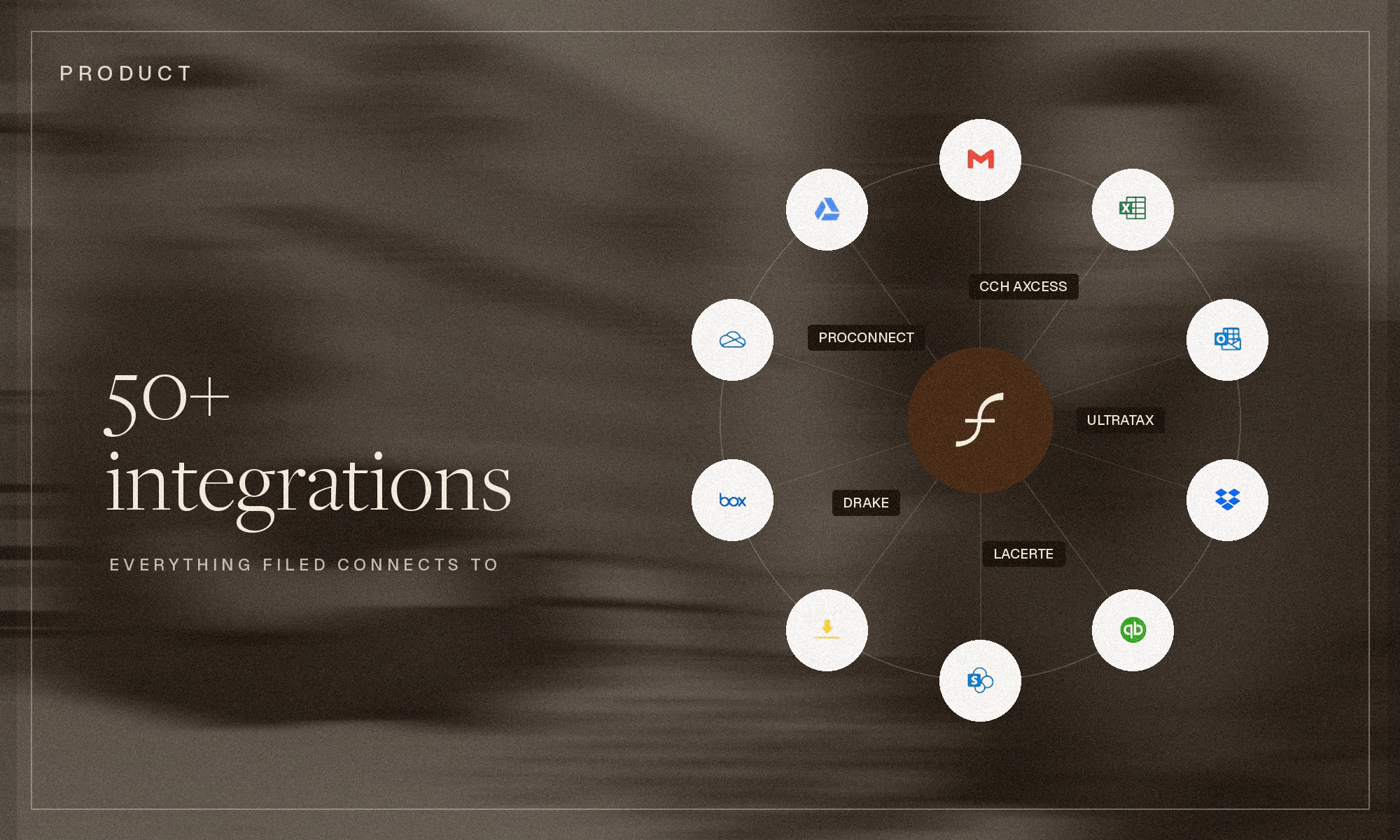
Yes. Filed supports CCH Axcess, UltraTax, Lacerte, Drake, and ProConnect, and handles 1040, 1065 with K-1, 1120, 1120-S, 1041, and 990 returns. Filed Reviewer works alongside any tax software without a migration, so firms keep their existing system of record.
Can AI automate business returns like 1065s and 1120s?
Partially, today. Filed reads business return source documents, extracts the data and prepares the entries; automated entry into the tax software currently runs for 1040s, so a preparer keys in the business entries. Entity automation is where the category is moving next, and it is harder than 1040 automation.
How much does AI tax software cost?
Models vary by vendor: per-return credits, per-seat licenses, or flat platform fees. Filed prices as one flat monthly platform fee for the whole firm, scoped to taxpayer count, with prep, review, and planning included and no per-return or seat charges.
If you want to see what a practitioner-endorsed import and review workflow looks like on your own returns, Filed Reviewer runs alongside your existing tax software and can be reviewing returns within a day.
Subscribe to our newsletter
Explore our latest insights
Discover valuable articles to enhance your knowledge.