
Share this post
India isn't your back office - it's your operating core
For many top-250 US accounting firms, India is not a back office. It is where a large share of their US tax compliance work gets done, by owned teams with their own prep groups, layered review and career paths. The constraint in those operations is rarely talent. It is technology that can't handle messy source documents, which pushes skilled accountants into manual data entry instead of review and judgment.
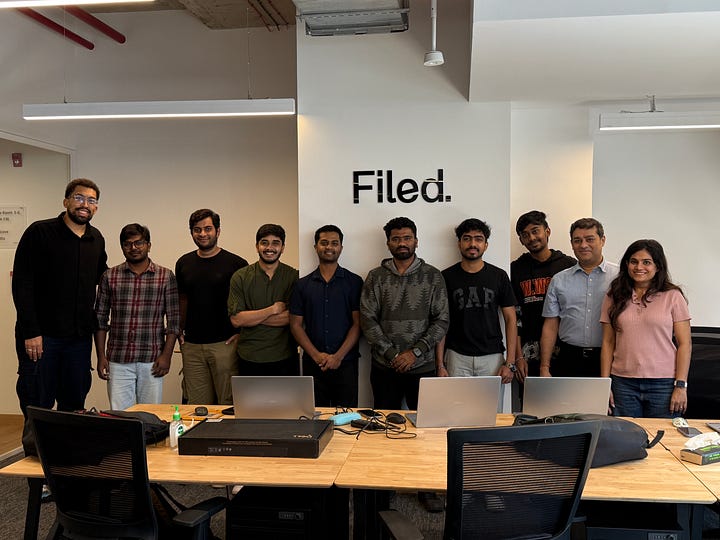
A few weeks ago I spent a week in Bangalore, inside the operations of one of our customers, running hands-on training sessions with their tax team. The days were long: whiteboard sessions in the morning, workflow walkthroughs in the afternoon, sitting directly beside preparers and reviewers as real returns moved through the system.
There's something clarifying about being inside the operation rather than talking about it from a distance. Now that I've been back for a few weeks, I've had time to reflect on what I saw, and I think most of the conversation about offshore tax work in the US is missing the actual story.

What does offshore tax work actually look like at top-250 firms?
At many top-250 firms, it looks like an owned tax practice with its own prep groups, reviewers and quality control.
The dominant narrative about offshore tax preparation in the US frames India as a cost play. Cheaper labour, back-office functions, work that's too simple or too repetitive for US-based staff.
That's not what I saw. When you step inside the large India operations that support US tax firms, India is not functioning as a peripheral back office. In many cases it is the operational engine powering the practice.
Many of the top 250 US firms are running scaled teams there. Owned entities under a group structure, with employees, directors, the firm's values on the wall, structured prep groups, layered review processes, quality control standards, and defined career paths. Some of these offices employ hundreds of professionals dedicated entirely to US tax compliance. These are not outsourced vendors. They are the firm.
How is the India tax talent pipeline different?
For many accountants in India, US tax becomes a true specialisation early in their careers. There's real exposure to volume and complexity from the start. Learning happens on the job, through repetition, feedback, and tight review cycles. Rather than easing into the work over several seasons, many are immersed in it immediately.
It produces sharp operators. These are qualified accountants who understand US federal and state rules, form mechanics, common review adjustments, and recurring edge cases. They're ambitious, motivated, and see long-term careers in this field. The talent level surprised me in the best way.
Is there a shortage of US tax talent in India?
No. The bigger issue is competition for experienced people.
What also surprised me: the market in India is increasingly competitive. The conversation there is less about a shortage of talent and more about a talent war. As larger US firms continue to open or expand India operations, experienced tax professionals are being recruited aggressively. Managers move between firms. Compensation is improving. The ecosystem is maturing quickly, and firms that underestimate that will struggle to retain strong teams.
This matters for any firm considering India as part of their strategy. The idea that you can set up an India operation and lock in long-term capacity cheaply is increasingly out of date.
Where do offshore tax operations break down?
The real constraint I kept observing wasn't the quality of people. It was the quality of systems.
One of the firms we worked with had been using the same incumbent technology for five years. Marketed as automated. In practice, it relied heavily on basic OCR and performed well only when documents were perfectly clean. Slightly messy PDFs, inconsistent formatting, or handwritten inputs frequently caused extraction errors. When that happens at scale, even small inefficiencies compound fast. Highly capable accountants end up spending a significant portion of their day correcting data extraction mistakes and manually entering numbers that a better system would have handled automatically.
That mismatch between skill level and task level creates a steady, low-level frustration. These are professionals who want to analyse, review, and apply judgment. Their tools force them into repetitive data entry instead.
What happened when we ran real returns through Filed?
Filed read a set of handwritten statements, checked them against the return and caught two genuine inconsistencies in the source documents.
During the visit, we ran real returns through Filed rather than staged demos. We uploaded a set of handwritten charitable contribution statements, the kind of documents that traditionally require manual handling. Our AI extracted the data, structured it, cross-referenced it against the return, and identified two genuine inconsistencies in the source documents.
The reaction in the room was not dramatic. It was practical. The team immediately understood what that level of automation meant for their day-to-day work. If the AI handles the first draft reliably, the accountant's role shifts upward: from data entry to review, validation, anomaly detection, and judgment. They begin to see patterns across hundreds of returns faster, which accelerates learning and sharpens instincts.
Why did Filed open an office in Bangalore?
A significant share of high-volume US tax work runs through India. If we want Filed to be genuinely designed for high-volume firms, we need to be close to that environment.
Our engineers in Bangalore have deep domain expertise and work directly with firms processing thousands of returns. They see real documents, real edge cases, and real workflow bottlenecks. That direct exposure shapes how we build. Instead of designing for idealized scenarios, we design for messy, high-throughput, real-world conditions.
Where is offshore tax work heading?
The firms that will lead over the next decade won't simply be those that move work across borders. They'll be those that combine global operations with AI-native workflows, elevate their teams from data entry to decision-making, and build tight feedback loops between the operators doing the work and the tax automation platforms they're using.
The conversation should not be about onshore versus offshore. It should be about how to design a global tax operation where talented professionals, regardless of location, work at their highest level. The talent is there. The ambition is there. The scale is there. The determining factor will be which firms pair that talent with systems that actually match it.
To see how that looks on your own returns, start with Filed Prep, which reads the client documents and prepares the first draft for your reviewers.
Frequently asked questions
Is offshore tax preparation in India just a cost play?
Not at most large firms. Many top-250 US firms run owned India entities with structured prep groups, layered review, quality control standards and defined career paths, and some of those offices employ hundreds of professionals who work only on US tax compliance.
Do US firms need client consent to send tax return information offshore?
Yes. Under section 7216 of the Internal Revenue Code and Treasury Regulation 301.7216-3, a US preparer needs the taxpayer's signed, written consent before disclosing tax return information to a preparer located outside the United States. For 1040-series returns, the SSN must also be masked unless an adequate data protection safeguard is in place.
Does Filed work for offshore and global tax teams?
Yes. Filed works inside CCH Axcess, UltraTax, Lacerte, Drake, and ProConnect, wherever the team sits. Filed reads the source documents, including messy PDFs and handwritten statements, and prepares the return across 1040, 1065 (with K-1), 1120, 1120-S, 1041, and 990 returns. Filed Reviewer then checks the draft against those documents line by line, so reviewers in any location start from a checked first draft. Filed is SOC 2 compliant, with ISO 27001 certification in progress.
Subscribe to our newsletter
Explore our latest insights
Discover valuable articles to enhance your knowledge.