
Share this post
Introducing Filed Prowork
The AI your firm teaches, inside the tools you already use.
There is a reviewer at your firm who catches things no software ever has. She knows which client’s brokerage statements double-count wash sales. She knows which partnerships send K-1s with the basis wrong, and she checks before she is asked. Twenty tax seasons live in her head, and every one of them made her harder to fool.
She is also one person. Her judgment reaches the returns she touches and none of the others. The firm is only as sharp as whoever happens to be reviewing that day, and when she retires, everything she knows walks out the door with her.
For two years the industry has argued about which AI model is the most accurate. We think that is the wrong question. The most accurate tax engine in the market already exists. It is your firm. The real problem is that it does not scale, and it does not stay.
Today we are launching Prowork, and that is the problem it solves.
What Prowork is
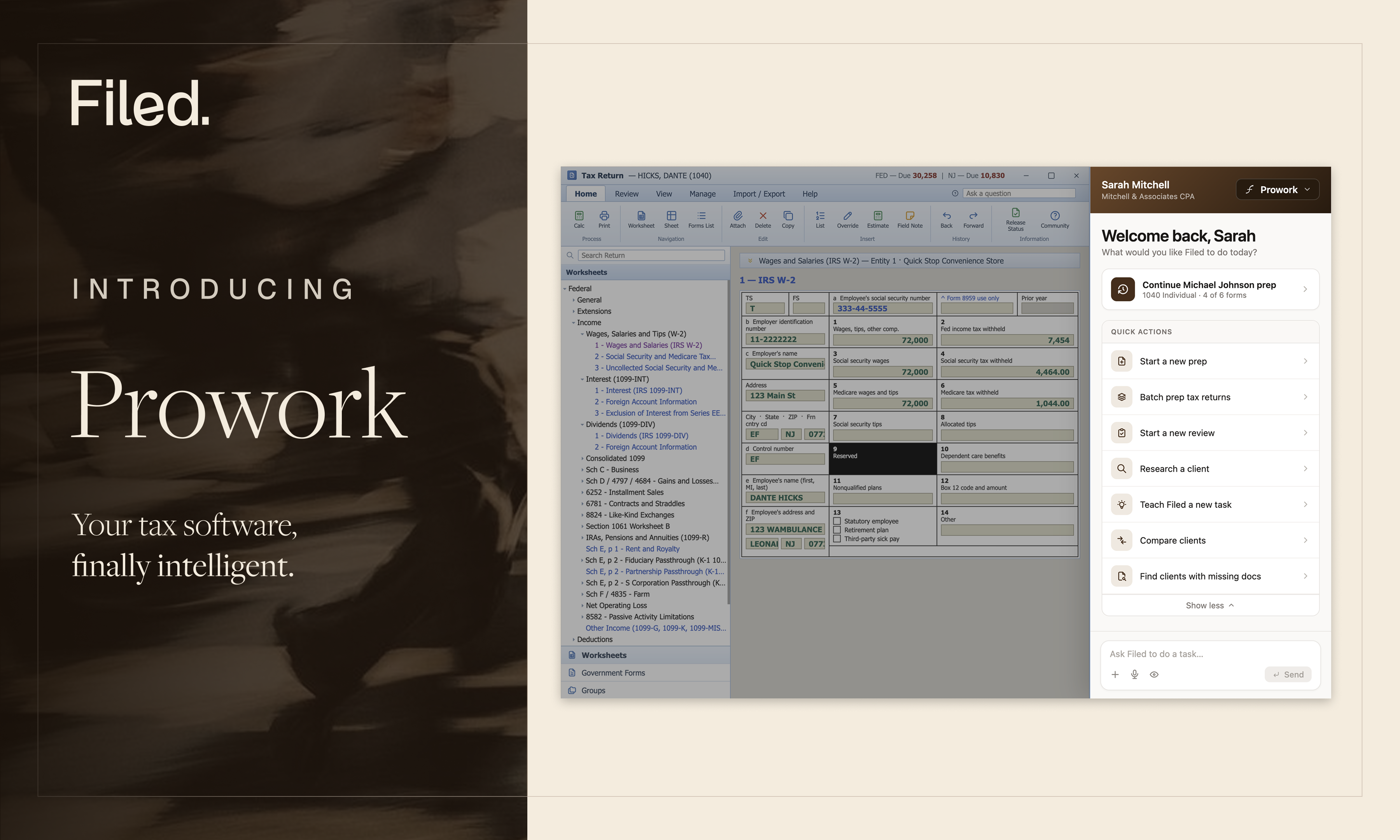
Prowork is an AI assistant that works where your team already works. It installs as a panel beside your tax software and as an add-in inside Excel. It prepares returns from the client’s source documents, reviews them line by line against those same documents, and builds complete workpapers on request.
Then it does the thing nothing else does: it learns how your firm works, and it never forgets. Every correction your team makes becomes a permanent rule that Prowork follows on every return after.
There is no new app to log into and no process to relearn before extension season. Your tax software stays exactly as it is. Prowork sits beside it, already caught up on the client.
A return, start to finish
Here is what it looks like in practice.
Documents arrive, and the work starts without you. The moment a client’s documents come in, Filed begins building the binder. It flags what looks missing, like a prior-year return, without blocking anything. And it does more than extract numbers. It reasons about what it reads. An unsigned business-expense invoice gets a note asking whether it was actually approved and paid. A pattern in a client’s IRA contributions gets noticed and carried forward.
Your preparers open a draft, not a blank return. Prowork enters the data into your tax software, and returns are processed in batches rather than one at a time through a queue. By the time a preparer opens the file, the figures the client actually sent are already on the forms.
Review happens on the form, not in another window. As a reviewer moves through the return, Prowork checks each figure against the source document behind it and calls out problems right where they sit. A wrong payer TIN on a 1099-NEC. A missing K-1. A suspended loss that should carry. An RSU basis adjustment nobody flagged.
It does not matter how the data got there. Hand-typed or imported, if a figure does not match the source, Prowork says so, and the source document is one click away. Confirm, fix, sign off, keep moving.
That last part is the point. The bottleneck in every high-volume firm is the gap between preparers and reviewers. When a draft arrives with its errors already surfaced and cited, that gap closes. Across our customers, review cycles are 64 percent shorter, and firms save an average of 42 minutes per return.
Workpapers build themselves in Excel. The Excel add-in is connected to all of the firm’s data in Filed. Pick a business client, ask for workpapers, and it builds the full book: income, Schedule Ks, depreciation, balance sheets, K-1s. It hands you an open-items list sorted by severity, so the things that need a CPA’s judgment, like a missing stock basis schedule, rise to the top. And if your firm already has workpaper templates it likes, give them to Filed and Prowork fills in your templates, your way.
The Playbook
Everything above makes your firm faster. This is what makes your firm smarter.
When Prowork gets something wrong, or handles it differently than your firm would, you correct it the way you would correct a junior. In plain English. The payer TIN is wrong. This is the right one. From now on, cross-reference it against this source document.
Prowork takes that instruction and builds it into how it operates. This is not a note in a memory that fades or drifts. The fix is structural and permanent. That mistake does not come back, on any return, for anyone at the firm.
Each saved instruction is a Protocol, and the collection of them is your firm’s Playbook. Protocols can be as small as a formatting preference and as large as a workflow:
You do not start from zero. Prowork ships with a starter set of Protocols covering the corrections firms make most, and your Playbook grows from there as your team works.
Why this compounds
A generic model is trained on everyone, which means it is trained on no one in particular. It is roughly as good in year three as it was on day one, and it treats a twelve-person firm and a two-hundred-person firm as the same customer.
A Playbook moves in the other direction. Every season it holds more of how your firm actually practices than the season before. The judgment that used to live in one reviewer’s head now lives in the work itself, applied to every return, retained through every departure.
And it is yours in the strictest sense. Prowork learns from your returns and only your returns. Your data never trains a shared model, and no other firm ever benefits from your Playbook. The asset you are building is your firm’s accumulated judgment, and it belongs to your firm.
Business returns, not just 1040s
AI review and workpaper generation are open now for entities: 1041, 1065, 1120, and 1120-S run through the same review and workpaper flow as 1040s. Automated data entry for entity returns follows later this summer.
Past the return itself
Because Filed holds your firm’s data, Prowork can reach further than a single file.
Ask the Tax Planner to look at a client and it reads their entire situation, then surfaces viable strategies sorted by estimated savings. Each one comes with an implementation plan, cited primary sources, and the risks. Select the ones you like and ask for a client-ready presentation, and it builds one. If a client mentions they might sell 20 percent of the business, feed in the hypothetical and the strategies re-run against it.
You can also ask questions of your whole book instead of one client at a time. Show me every client with a consolidated brokerage statement. Split my 2,000 clients into these three groups and run this report on each. Answers that used to be a staff project become a sentence.
What firms are seeing
Teel Accounting put it better than we could:
“I went from working 7 a.m. to 9 p.m., pretty much seven days a week, to working from 7 to 5, going home, having dinner, putting my kid to bed.”
Teel Accounting
That is the outcome we care about. Not a demo that impresses, a season that ends at dinner time.
The practical details
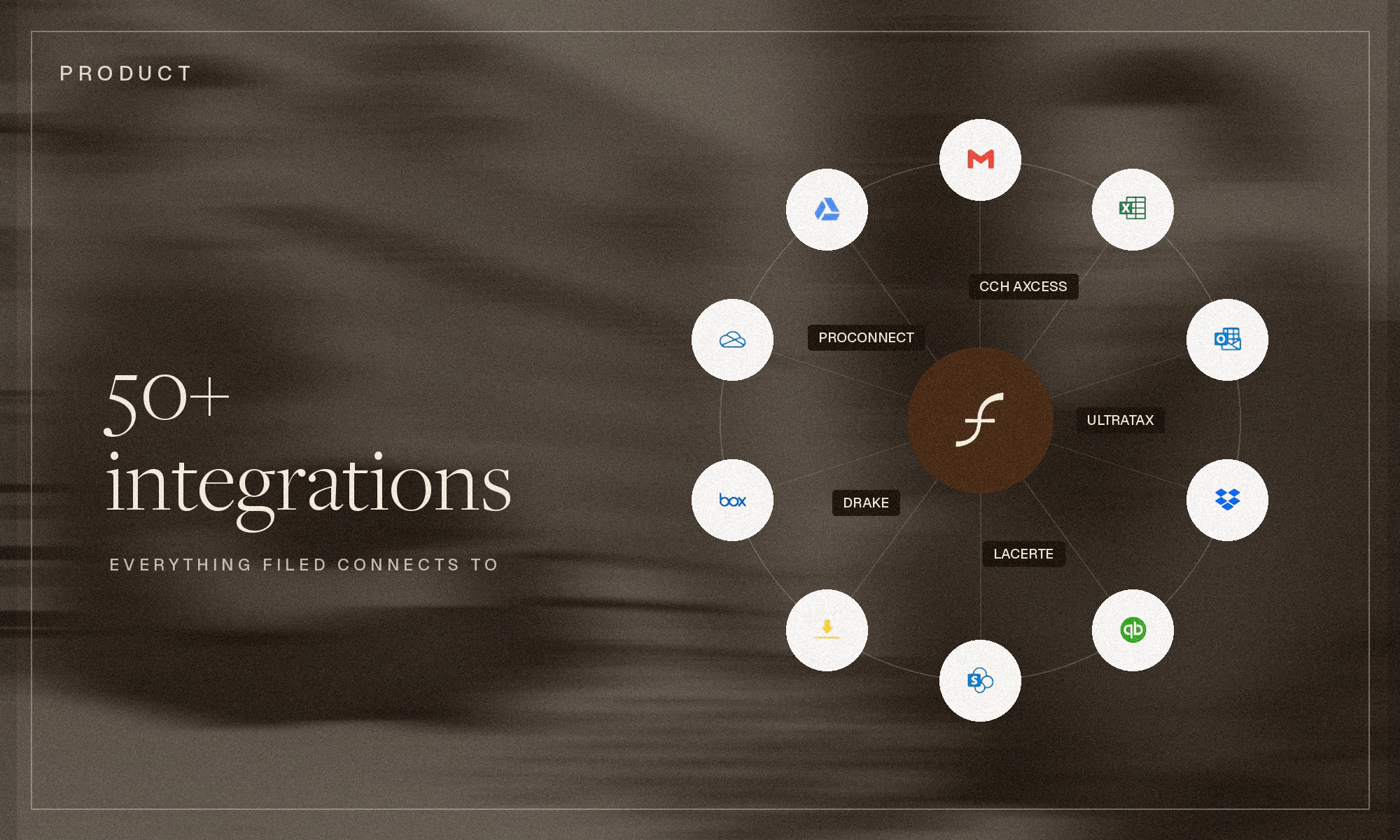
Prowork works alongside CCH Axcess, UltraTax, Lacerte, Drake, and ProConnect, across 990, 1040, 1041, 1065, 1120, and 1120-S returns. Side panels for Outlook and Gmail, which pull a client’s details into your inbox the moment they email, arrive later this summer.
Prowork comes with Filed. One flat platform fee, unlimited usage, nothing feature-gated. Review, workpapers, and planning are all included. And every engagement carries a 60-day money-back guarantee: if it is not working for your firm, you get every dollar back.
Learn more about Filed Prowork
Subscribe to our newsletter
Explore our latest insights
Discover valuable articles to enhance your knowledge.