
Share this post
Will AI replace accountants? What the evidence says
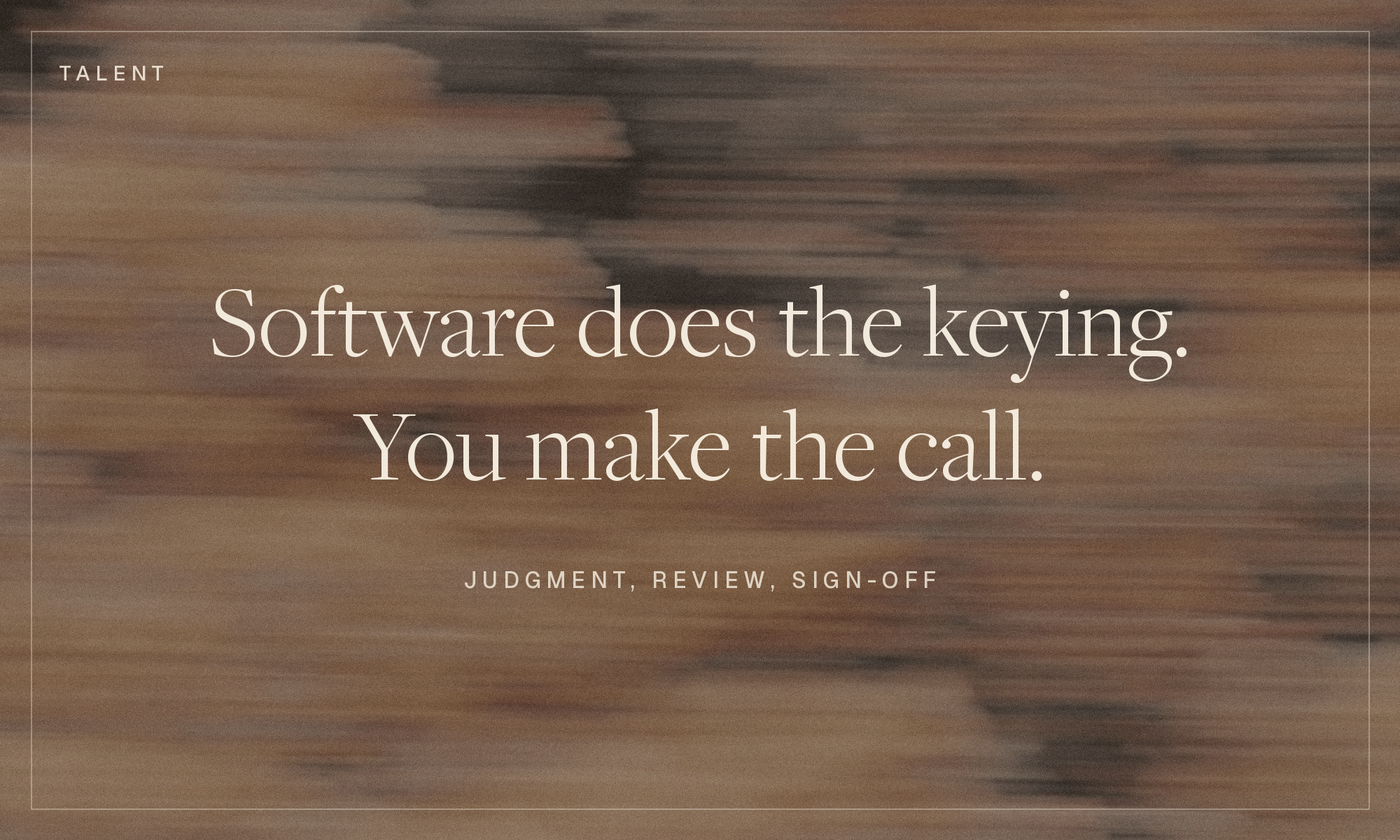
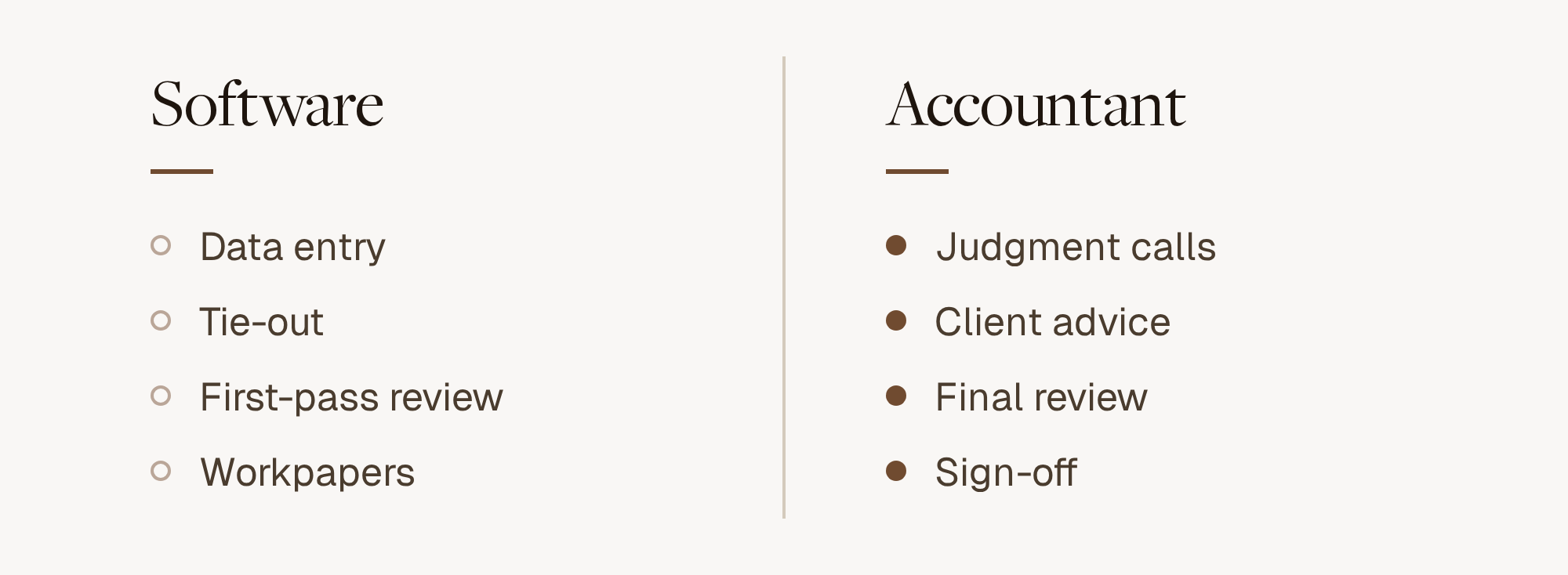
Will AI replace accountants? No. But it is replacing a large share of what accountants spend their hours on. Data entry, tying source documents to the return, and first-pass review are moving to software. Judgment, client relationships and the signature on the return stay with people, and those parts of the job are becoming more valuable. The accountants most exposed are the ones whose week is mostly keying and checking.
That answer comes with a catch that gets less attention than the headline question. The work being automated first is the work that used to train junior staff. The top of the profession is safe. The path into it is changing, and firms that plan for that will be in much better shape than firms that assume busy season will look the same in five years.
What accounting work is AI actually taking over?
AI is taking over the mechanical, rule-bound parts of tax and accounting work: reading documents, moving numbers and checking that numbers match. In a typical tax practice that means:
- Document intake and data entry. Reading W-2s, 1099s, K-1s, brokerage statements and prior-year returns, then getting the figures into the return.
- Tie-out. Checking every figure on the draft return back to the document it came from.
- First-pass review. Catching the transposed digit, the 1099-DIV nobody entered, the carryforward that didn't carry.
- Workpaper assembly. Building the binder and the supporting schedules a reviewer expects to see.
What these tasks share is that a correct answer exists and can be checked. That is where current AI performs well, and it is where a tired preparer at 11pm in March performs worst.
What isn't moving is the work with no single right answer in the documents. Should this S-corp election still stand? How conservative a position should the firm take on a gray-area deduction? What do you tell a client whose K-1 arrived three weeks before the extended deadline with numbers that don't match their own records? Those calls need someone who knows the client, knows the law and will put their name on the result.
What does the job data say about the future of accounting?
The federal data points to steady growth. The Department of Labor's O*NET profile for accountants and auditors, which draws on Bureau of Labor Statistics projections, shows about 1.58 million people employed in the occupation in 2024, projected growth of 5% to 6% from 2024 to 2034 (faster than average), and roughly 124,200 openings a year from growth and replacement. The occupation carries a "Bright Outlook" flag.
Projections are built on past patterns, so they can lag a technology shift, and it would be dishonest to treat them as a guarantee. But the demand side of the future of accounting isn't in doubt. The tax code keeps getting longer, clients keep getting more complicated, and in our experience most mid-sized firms are limited by capacity rather than by a shortage of work. AI changes how firms build that capacity. The need for skilled people stays.
Why can't AI sign off on a tax return?
Because responsibility for a return belongs to a person, and the rules say so. Treasury Department Circular 230, the regulations governing practice before the IRS, puts duties on the practitioner: due diligence as to accuracy (section 10.22), standards for return positions (section 10.34), and procedures that the people running a firm's tax practice must put in place to keep the firm compliant (section 10.36). Preparer penalties under Internal Revenue Code section 6694 land on the preparer, too. No software vendor carries that liability.
Circular 230 already allows a practitioner to rely on someone else's work product if they used reasonable care in supervising and evaluating it. The regulation predates these tools and doesn't mention them, but that is a sensible working rule for AI output: supervise it, evaluate it, and never treat it as the signature. As more of the return is drafted by software, the person who checks it becomes the control, and review carries more weight each year.
Will AI replace CPAs, or change what they do?
AI changes what CPAs do, and the change lands hardest at the entry level. The traditional firm runs as a pyramid: juniors key and tie out, seniors review, partners sign and manage client relationships. Juniors learned the job by doing the data entry. That is exactly the work being automated first.
The bigger risk for the profession is a cohort of seniors who never built the pattern recognition that comes from preparing a few hundred returns by hand, and who are then asked to review machine-drafted returns without knowing where they tend to go wrong. For experienced CPAs, the shift runs the other way: less time re-preparing a junior's work, more time on exceptions, planning and conversations clients will pay for.
What skills will accountants need next?
The skills that matter next are the ones that check, explain and decide. None of them require learning to code.
- Reviewing machine output. Knowing where models tend to slip (unusual K-1 footnotes, state apportionment, basis tracking, anything that depends on facts outside the documents) and checking there first. Our breakdown of whether general chatbots can prepare tax returns shows the kinds of errors to look for.
- Reading source documents fluently. When software reads the document for you, you still need to know what a correct reading looks like.
- Judgment on gray areas. Positions, elections, timing and the level of risk a particular client can live with.
- Client communication. Turning a flagged variance into a conversation the client understands and acts on.
- Writing down the firm's standards. A tool can only apply your review standards consistently if someone has made them explicit.
What should accounting firms do now?
Move the mechanical work to software on purpose, and redesign training so junior staff still learn judgment. A practical sequence:
- Map where busy-season hours go. Sort tasks into two piles: ones with a checkable right answer, and ones that need a call.
- Automate the first pile with tools that show their work. Every flag should cite the source document so a reviewer can verify it in seconds. Our guide to AI tools for tax professionals covers what to test for.
- Rebuild the junior path around review. Have first-years check AI-prepared returns against the source documents, with a senior checking their checks. They learn the return by interrogating it.
- Capture your corrections. If reviewers fix the same issue every season, that fix should become a rule the software applies every time.
- Keep sign-off human and documented. Record who reviewed what, consistent with your Circular 230 procedures.
This is the split Filed is built around. Filed reads the client's documents and prepares the return across 1040, 1065 with K-1, 1120, 1120-S, 1041 and 990 returns, working with CCH Axcess, UltraTax, Lacerte, Drake and ProConnect. Filed Reviewer compares the source documents against the draft return line by line and cites each finding, so the reviewer verifies instead of re-preparing. Prowork sits beside the tax software and reviews inline as the preparer works; when a reviewer corrects it once in plain language, Prowork hard-codes the fix as a permanent skill, on top of about 35 pre-built ones. Firms using Filed have seen 64% shorter review cycles and 42 minutes saved per return. The CPA still makes the call and signs.
Frequently asked questions
Will AI replace accountants in the next 10 years?
The evidence says no. Federal projections show employment of accountants and auditors growing 5% to 6% from 2024 to 2034. What will change is the mix of work: far less data entry and manual tie-out, more review, advisory and client work.
Will AI replace CPAs?
No. A CPA's value sits in judgment, professional responsibility and the signature, and Circular 230 places the duty of diligence on the practitioner. AI shifts CPA time from checking arithmetic to supervising output and advising clients, which lets one CPA handle more returns well.
Is accounting still a good career with AI?
Yes, with a different starting point. Entry-level work is moving from keying data to reviewing AI-drafted work, so people who learn to read source documents closely and question a return early can progress faster than the old pyramid allowed.
How does Filed work alongside a firm's accountants?
Filed does the analytical work and the accountants do the judgment work. Filed reads source documents, prepares the return and reviews it line by line with citations, then a preparer or CPA verifies the findings and signs off. Filed is SOC 2 compliant, with ISO 27001 certification in progress.
If you want to see that split on your own firm's returns, book a demo.
Subscribe to our newsletter
Explore our latest insights
Discover valuable articles to enhance your knowledge.